
Where should you place the cue ball with ball in hand? First confirm where placement is allowed under your rules. Choose a makeable legal shot, picture the next position, then place the cue ball where you can reach comfortably and deliver a controlled stroke. The easiest shot is not always the best position choice.
Start with the rules, not the placement
Ball-in-hand rights depend on the game and the situation. Under many WPA pool situations, the incoming player may place the cue ball on the playing surface, but some situations restrict placement. House and league rules can differ. Confirm the ruleset and whether a head-string restriction applies before you move the ball.
Place the cue ball carefully without touching an object ball. Leave room for your bridge and cue. A technically legal position can still be awkward if the rail or another ball interferes with your setup.
Choose the pocket and the next position
Before placing the cue ball, look at a legal object ball and the pocket you intend to use. Then identify the next ball or useful area of the table. Give the cue ball a destination after the first shot.
A straight-in shot may make pocketing simple but leave little natural movement toward your next target. A modest angle can create other position options. More angle also changes the difficulty and cue-ball path. Your job is to balance a makeable shot with a manageable next position.
Use the ghost ball as a starting reference
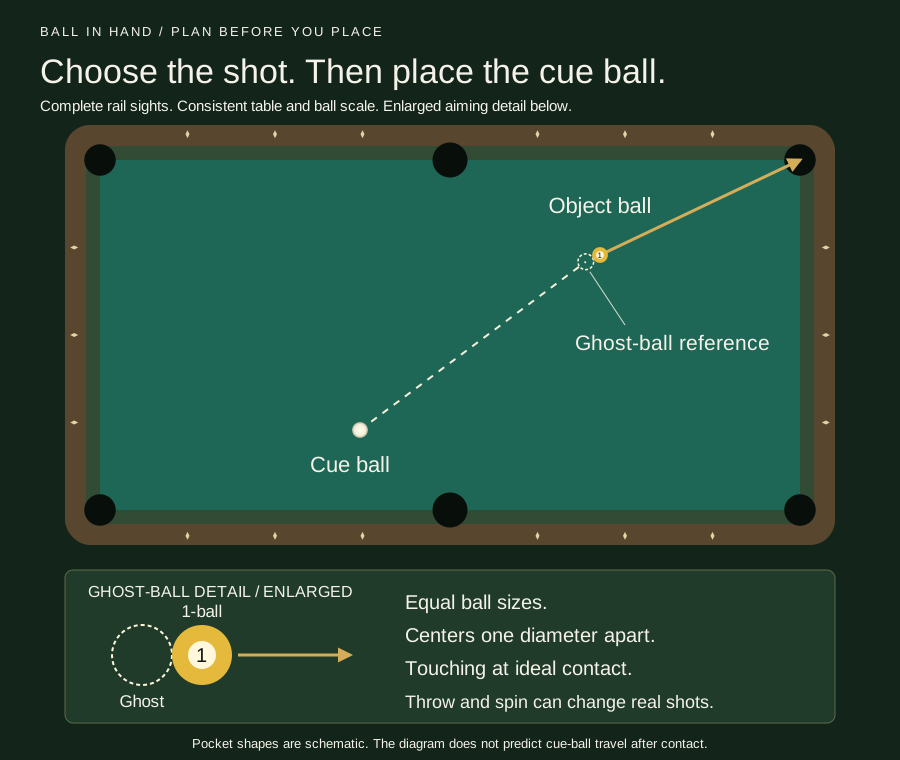
Imagine another cue ball touching the object ball on the line that leads away from the pocket. Its center sits one ball diameter behind the object-ball center. That imaginary center is a useful reference for where the real cue-ball center needs to arrive for the idealized collision.
This model simplifies the geometry. Real shots can be affected by throw, spin, speed, and contact conditions. Use the reference to understand the line, then test it at the table. Do not treat a drawing as an exact optical or physical simulation.
Make space for a comfortable delivery
Try the stance and bridge before settling on your placement. If you cannot get comfortable, adjust the cue-ball position while you still have ball in hand. Prefer a shot you can deliver smoothly over a clever-looking position that forces a cramped stroke.
Keep your first attempts simple. Start with little or no sidespin, modest speed, and an achievable cue-ball target. Increase the difficulty only after you understand the basic result.
A practical comparison drill
- Choose an object-ball position and a pocket, plus a target area for the cue ball after the shot.
- Try one comfortable cue-ball placement five times. Record pockets made and position results separately.
- Try a second placement with a modestly different angle five times.
- Compare both sets using the same target and table conditions.
- Keep the option that works better for you in that trial. Repeat on another day before drawing a broad conclusion.
The point is to learn from the table. A position that looks easier in a diagram may be harder with your bridge, reach, speed control, or table conditions. Let the observed results inform your next practice.
Should I always leave myself an angle?
No. The right placement depends on the shot, next position, rules, and your ability to control the result. Sometimes a straight shot is sensible; sometimes a manageable angle helps. Look for the simplest reliable route for the actual table in front of you.
Ball-in-hand placement can depend on the game and local rules. Confirm the placement rule before you shoot.