How do you control the cue ball? Start with three spin conditions at object-ball contact: topspin for follow, sliding with no top or backspin for a straight stop shot, and backspin for draw. Your tip placement helps create those conditions, but distance, speed, and cloth change what arrives at the object ball.
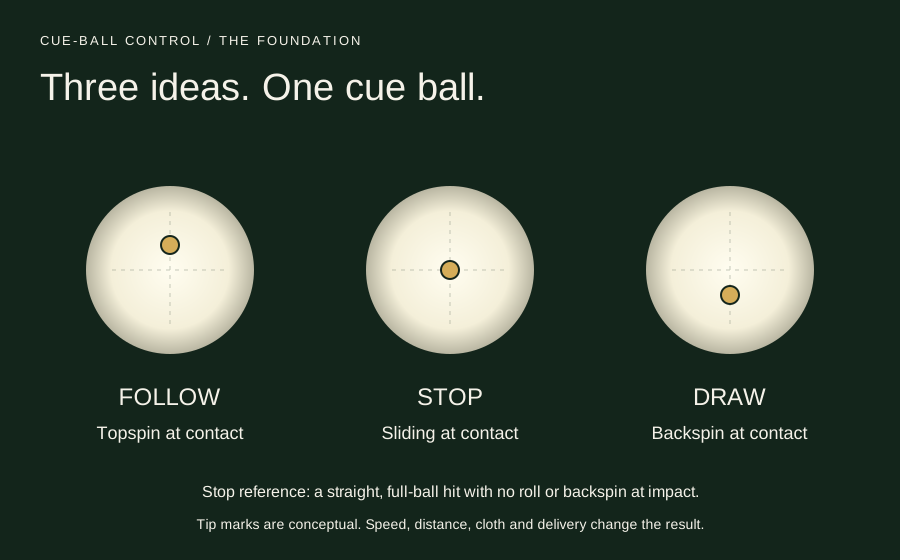
Think about contact, not just where you aim the tip
A cue ball changes as it travels. The cloth can wear away backspin, and a sliding cue ball can begin rolling forward. That is why the same tip position can produce different results when you change the distance to the object ball.
For this practice, use an easy, straight-in shot. Keep the cue as level as your setup allows, build a stable bridge, and deliver a smooth stroke. Begin with modest speed. Leave sidespin out of the exercise so you have fewer variables to manage.
Follow: let the cue ball roll forward
Aim a little above center to help create forward rotation. On a straight shot, a cue ball that arrives with topspin can continue forward after contact. Begin close to the object ball and watch the result before trying to send the cue ball a long way.
Choose a small target area beyond the object ball. Your goal is to learn a repeatable result, not to hit as hard as possible. If you pocket the ball but miss your position target, record both facts. Making the ball and controlling the cue ball are two related skills.
Stop: arrive sliding on a straight shot
A stop shot requires a full, straight hit with the cue ball sliding at contact, without topspin or backspin. The tip height and speed needed depend on distance. At longer distances, some initial backspin may be needed so it wears off near the collision.
Watch carefully: rolling forward after contact means you had follow; coming back means backspin remained. Moving sideways can mean the hit was not truly straight. Do not use a stop-shot result as a promise about a cut shot: a sliding cue ball on a cut travels along the tangent line rather than simply stopping.
Draw: keep backspin until the collision
Strike below center with a chalked tip and a controlled delivery. For a straight draw shot, backspin must still be present when the cue ball reaches the object ball. Start with a short distance so friction has less time to remove that spin.
More force is not always the answer. Check the actual contact point, a steady bridge, and whether your cue lifts during the stroke. Stay within a comfortable tip offset; repeated miscues are a reason to reset your setup and technique.
A simple 15-shot practice
- Choose one easy, straight-in setup. Keep the ball locations consistent.
- Try five follow shots. Note whether the cue ball finishes in your chosen area.
- Try five stop shots. Look for the cue ball to stop at contact.
- Try five draw shots. Begin by asking for a small, controlled return.
- Write down what happened before changing speed or distance. Change only one variable in your next set.
Your notes are a baseline, not a grade. Compare the same setup the next time you practice. Consistency gives you useful feedback.
Quick answer: why does my draw shot turn into follow?
One possibility is that the cloth removed the backspin before the cue ball reached the object ball. Start closer, check the actual tip contact, and make a controlled adjustment. A coach can help distinguish distance and spin issues from alignment or delivery problems.